Computational infrastructure for process control, robotics, and manufacturing.
The solver that doesn’t crash when sensor data degrades. Digital twins where the edge and the cloud actually agree. Control loops that know how confident they are — and an evidence base built to survive IEC 61508 review.
Four audit-ready POCs. Every claim is a captured number.
Each POC opens with a plant scenario, walks through what changes when our solver is in the loop, and ends with benchmark numbers your process engineers can verify.
One computational engine. Eight domains it changes.
The same noise-stable solver, embedded-first design, and audit-grade evidence base show up across process control, robotics, predictive maintenance, anomaly detection, and safety certification.
Process Control
Self-regulating loops that back off when sensors degrade
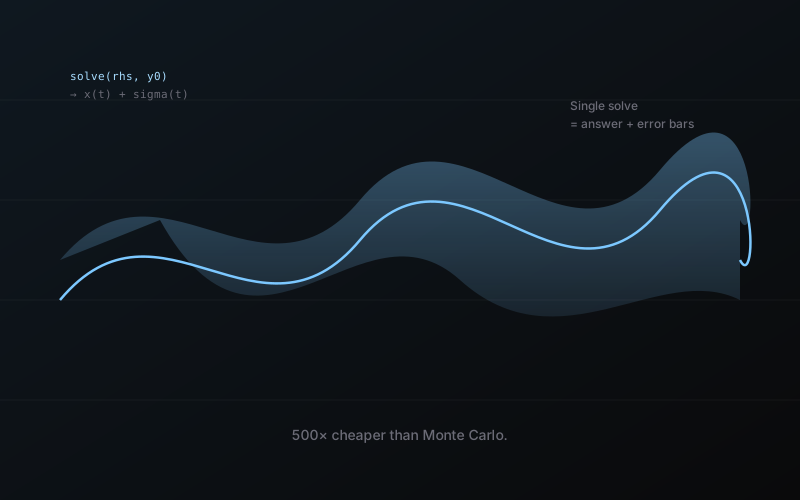
Industrial control loops run on fixed PID gains tuned for nominal conditions. When a thermocouple drifts, a flow meter cavitates, or a vibration sensor saturates, the loop either overshoots into a trip or limps along at conservative setpoints. SolvSRK-UQ tracks state-space uncertainty inside the solve and exposes it as a control signal - the loop tightens when instruments are clean and widens automatically when they aren't.
SolvSRK-UQ
Robotics & Motion
Multi-regime manipulator dynamics without per-regime tuning
A 6-DOF manipulator arm transitions between free-space slew, contact approach, and loaded manipulation - three stiffness regimes that standard solvers handle with three separate tuning profiles. SolvSRK's hybrid architecture handles all three in a single configuration, validated on SCARA 4-DOF and 7-DOF manipulator benchmarks with impedance-parity against LSODA across the full workspace.
SolvSRKSolvSRK-UQ
Predictive Maintenance
Digital twins where edge and cloud actually agree
Predictive-maintenance twins fail because the on-machine model and the cloud model are different software running on different hardware. A divergence alert could mean a real bearing fault or a numerical artifact - and the maintenance team cannot tell which without a truck roll. SolvSRK runs the same compiled binary on the PLC and in the cloud, so divergence means a real fault, not a software mismatch.
SolvSRKSolvNum
Sensor Anomaly Detection
Model-free regime-change detection on process instruments
Industrial sensor buses carry hundreds of channels - temperature, pressure, vibration, flow, current, pH. Conventional anomaly detectors are ML classifiers trained on one operating profile that generate false alarms when the plant changes mode. SolvNum's scale-discontinuity detector fires on a 4× or larger jump in any channel - zero training data, zero retuning, one integer comparison per sample.
SolvNumSolvScout
Embedded Deployment
Same solver on the workstation, the HIL rig, and the PLC
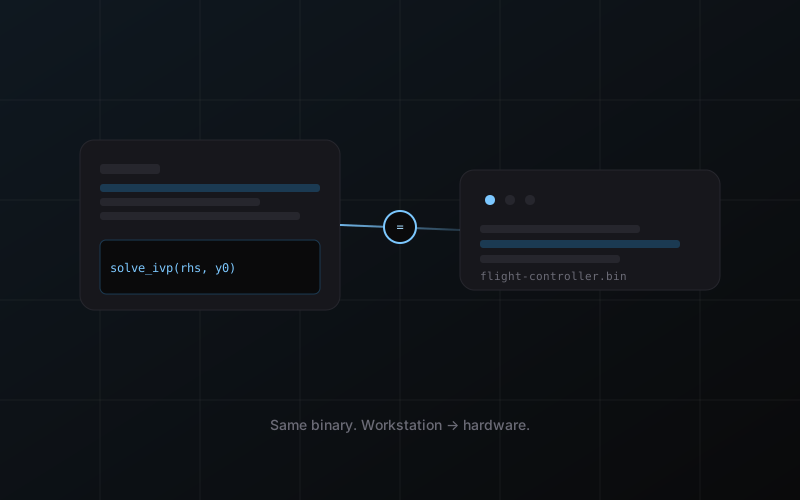
Commissioning a new control algorithm means closing the gap between the solver that worked in MATLAB and the solver that runs on the target PLC or embedded controller. SolvSRK is one C-native solver that runs in both places with identical behavior - validated for 100,000 integration steps with no drift, across stiffness regimes from gentle dynamics to eigenvalue ratios of 10⁶.
SolvSRKSolvNum
Solver Selection & Audit
Pick the right solver for the plant - with evidence
Every industrial simulation package ships with a default solver, and most engineers never change it. When the simulation fails or produces suspicious results, the first question is always 'was the solver appropriate for this system?' SolvScout fingerprints your ODE system and benchmarks every candidate solver against it - dead zones called out, not hidden. SolvJump study runs archive the decision for IEC 61508 review.
SolvScoutSolvJump
Deterministic Replay
Bit-identical replay for incident investigation
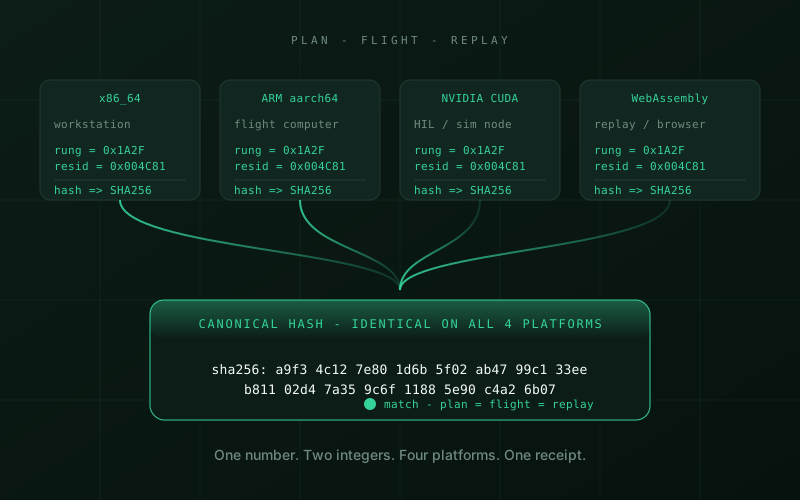
When a batch goes off-spec or a robot arm collides, the incident investigation needs to replay the control system's math exactly as it executed. Today, replaying on a different workstation produces different last digits. SolvNum produces bit-identical arithmetic across x86, ARM, GPU, and WASM - the replay matches the original execution, attestable by SHA-256.
SolvNumSolvJump
Commissioning & Certification
IEC 61508 / ISO 13849 evidence from the solver layer
Functional safety certification for industrial machinery requires demonstrating that the control system behaves within documented bounds. SolvSRK enforces a per-step excursion limit by design - a guaranteed property of the solver, not a runtime assertion in application code. The certification question 'show me the upper bound on per-tick command change' is answered in one line, not in a multi-week code review.
SolvSRK-UQSolvNumSolvJump
Want to see the numbers on your own plant?
We offer a bounded-scope benchmark against a sanitized model of your actual process. Two weeks, fully credited toward a Year-1 license. Every numerical claim traces back to a test ID and a verdict.
The industrial product line on top of one computational engine.
Each product brief below opens with a scenario your plant engineers will recognize, then walks through what it is, who uses it, why it’s defensible, and how the claims survive safety review.
Built for teams that have to survive safety review.
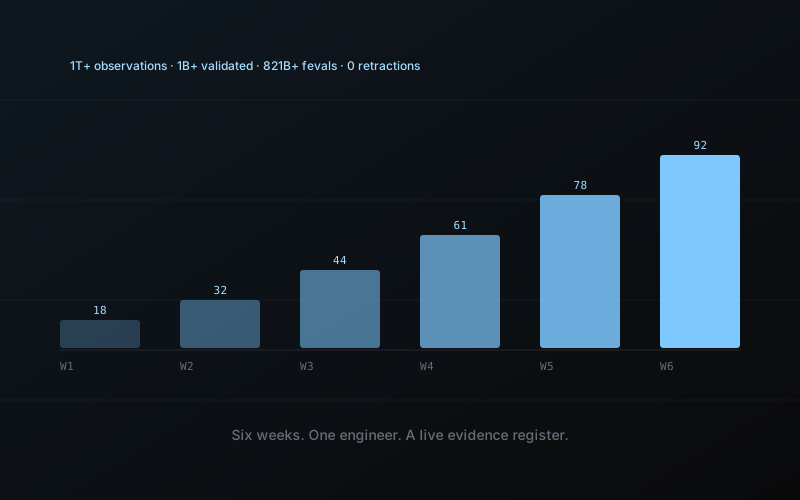
Bounded-scope benchmark on your actual process model in two weeks. Shadow run alongside your existing control system for one month. Production pilot on one loop, one line. Every option credits in full toward a Year-1 license. Every numerical claim traces back to a test ID, a seed, and a verdict in a live evidence register.